Whose Imagined Future Are We Building?
Reflections on science fiction, progress, selection, and whether civilizations share evolutionary patterns across scales.
Whose Imagined Future Are We Building? Reflections on Progress, Natural Selection, and Historical Inevitability
01. Science fiction and the future
I have long felt that science fiction’s role in the modern history of technology is underestimated.
In the 1950s and 1960s, Asimov, Clarke, and others almost defined the future we imagine today: flying cars, Mars colonies, interstellar travel, and even galactic empires.
For decades since, countless scientists and engineers have worked toward those goals.
Yet these futures were not deduced from natural laws. Physics does not require humanity to colonize Mars, and biology does not require civilization to spread across the galaxy.
They were desirable futures imagined by people of a particular era.
Science fiction plays part of the role of philosophy of science here. Science tells us what is possible; science fiction asks what is worth bringing into existence.
More intriguingly, over sixty years later, we are still trying to realize those twentieth-century visions.
Technology keeps advancing, but our grand narratives about the future do not seem to have changed to the same extent.
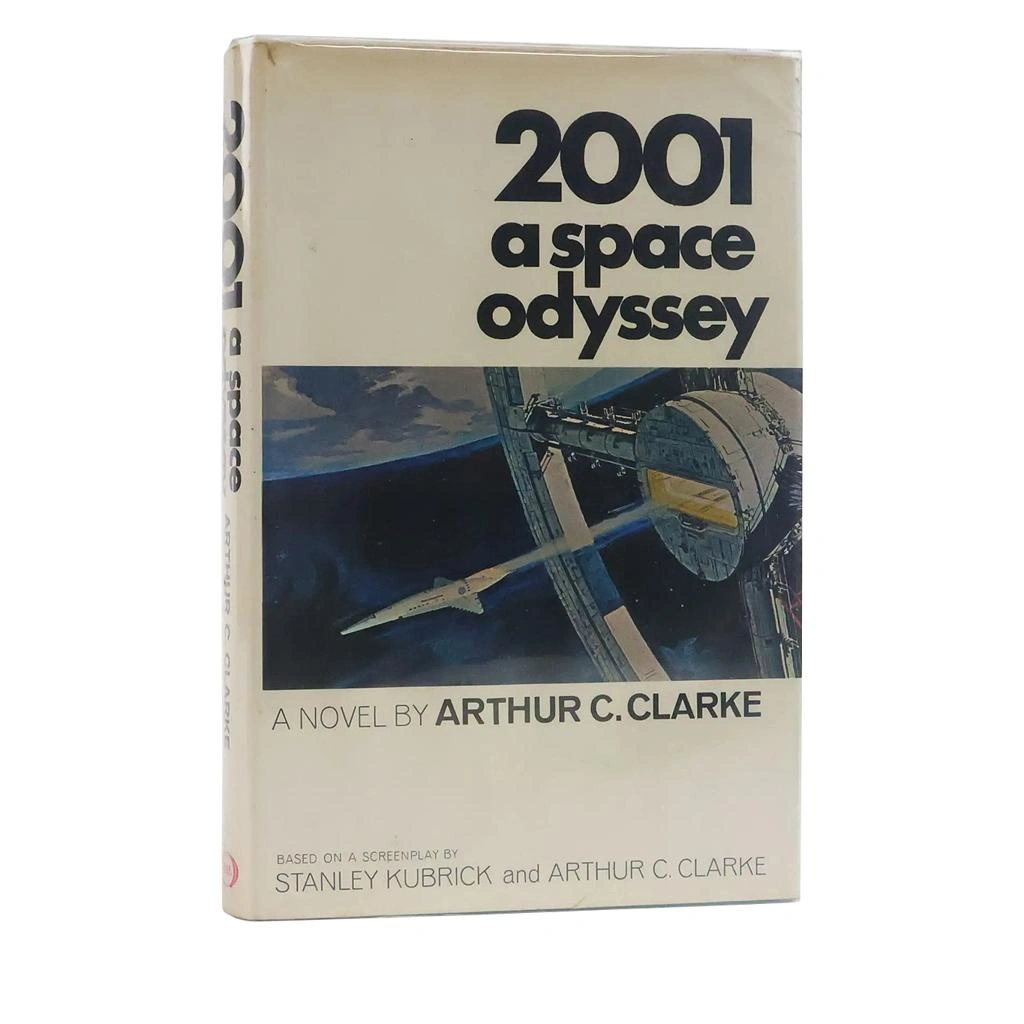
2001: A Space Odyssey, Arthur C. Clarke, 1968.
02. Why do we need a desirable future?
I think we can approach this both rationally and emotionally.
Rationally, increasing specialization usually improves production efficiency.
If humanity becomes a civilization spread across multiple star systems, different planets might develop different economic structures, industries, and even ideologies. Their division of labor could resemble today’s division of labor among nations.
Of course, interstellar transport and communication might be extraordinarily costly. Specialization may occur less in material production than in knowledge, technology, or institutions.
Emotionally, the point is not that the future must be better than the present.
It is that we want to believe—or do not want what we currently call meaningful to become ultimately useless.
We hope today’s exploration and accumulated knowledge will become part of a future civilization, even if the outcome is uncertain.
At a macroscopic level, however, rationality and emotion may not be fundamentally different.
Apparently irrational long-term commitments can themselves change resource allocation and collective behavior, becoming part of civilization’s evolutionary dynamics.
Individuals appear to choose their destinies, yet civilization as a whole remains subject to certain objective constraints.
03. Renormalization in the evolution of civilization
I tend to think civilization’s evolution has objective directions—but more than one.
If we treat civilization as a high-dimensional dynamical system and repeatedly coarse-grain it, perhaps only a limited number of macroscopic evolutionary patterns remain.
This resembles universality classes in the renormalization group.
At the microscopic level, civilizations have very different cultures, institutions, and histories. At sufficiently large scales, some differences might become irrelevant, leaving similar dynamical structures.
There might be dozens or hundreds of macroscopic attractors, while the specific historical trajectory depends on chance and path dependence.
This is only a conjecture for now. We have not even defined a renormalization operator for social systems, let alone proved that fixed points exist.
Historical contingency does not contradict objective regularities in macroscopic evolution.
04. Matter, selection, and death
Where, then, do evolutionary directions come from?
First, 1. thermodynamics.
A complex system far from equilibrium needs continuous free-energy input and dissipation to maintain its structure. Imbalances in matter and energy provide a driving force, but do not guarantee that complex structures will appear.
Competition, cooperation, and natural selection shape 2. its dynamical structure.
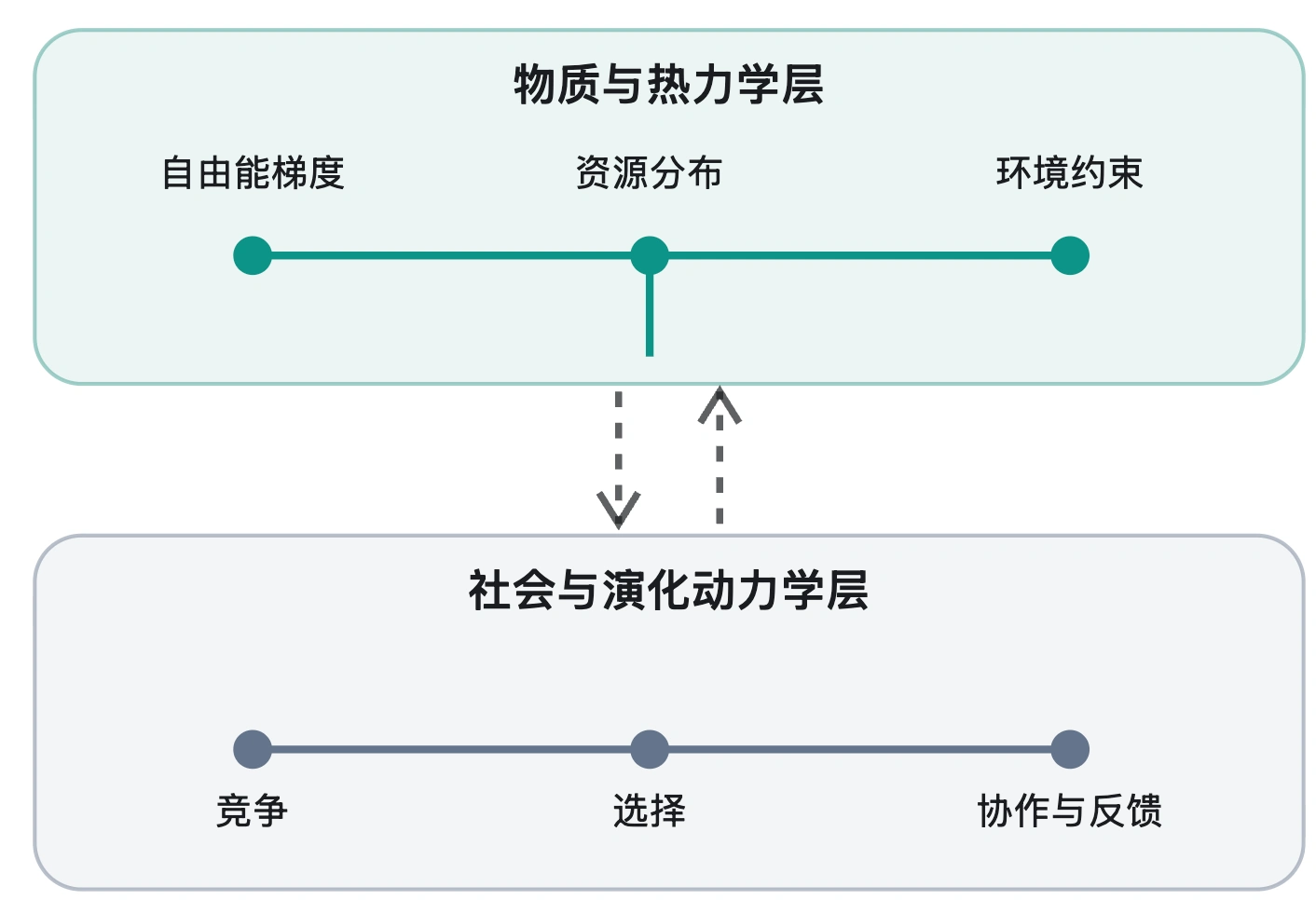
Let us move down a scale and consider cells.
Cells have countless phenotypes, yet many share highly conserved survival and death signaling pathways. Why have these regulatory mechanisms persisted through evolution?
Death seems a useful starting point. For unicellular organisms, death is largely shaped by the environment, metabolism, and accumulated damage.
Once part of a multicellular organism, however, a cell may undergo apoptosis after losing a survival signal even when nutrients are plentiful. A higher-level system has begun imposing new conditions for survival on lower-level individuals. Natural laws have not changed, but multicellular society has added more laws.
Particular growth factors may only be the visible expression of something more deeply conserved: an architecture regulating survival and death, through which a system expands its adaptive margin. Perhaps the fundamental evolutionary constraint is not survival but the possibility of death.
The universal values of a society of cells.

A more general theory of constraint hierarchies.
Conserved pathways, however, are not equivalent to RG fixed points. They might also reflect common ancestry and historical path dependence.
The structure is intriguing: constraints produce selection, selection shapes organization, and new organization creates new constraints. Similar recursive processes appear from cells to tissues and from individuals to societies.
05. The emergence of constraints
I have always found interpretations of evolution interesting.
Continuing that line of thought: why do systems evolve increasingly complex regulatory mechanisms?
One possible explanation is that, in changing environments, systems capable of sensing, remembering, and adjusting their behavior are more likely to persist.
Cells maintain homeostasis through membrane transport; animals regulate their internal environments through circulatory and endocrine systems; humans alter environmental survival constraints through agriculture, medicine, and social institutions.
In other words, systems continually acquire the ability to create, maintain, and adjust their own boundary conditions.

But I do not think systems can ultimately escape selection pressure.
This brings Gödel’s incompleteness theorems to mind. They cannot directly establish evolutionary limits in the physical world, but suggest a way to think about limitations internal to a system.
Every evolutionary process obeys the fundamental physical laws of its universe. New control capabilities do not confer an arbitrary ability to eliminate underlying constraints. Each new organizational level also introduces new dependencies and modes of failure.
Evolution continually changes the scales at which constraints operate. Boundary conditions impose hard constraints and also bias selection through differences in stability, reachability, and dynamics.
06. Progress is subjective
This brings us back to a distinction between evolution and progress.
Evolution can have objective regularities; progress is a value judgment. Modern civilization has experienced expansion, specialization, increasing productive efficiency, and growing emphasis on individual value, and has retrospectively called these changes progress.
Why must a galactic empire be more advanced than an Earthbound civilization? Why must a larger economy mean a better life?
Natural laws cannot answer these questions directly.
We first experience changes, then interpret them as progress.
That interpretation becomes a driving force in the next stage of evolution. Believing that accumulating knowledge is progress, we build universities and research institutions. Believing space exploration represents the future, we invest in aerospace technology.
Science fiction contributes to this process. It does more than offer enticing promises: it creates tastes and preferences for future states.
07. Why do we keep predicting the future incorrectly?
Unfortunately, science fiction shares a limitation with other attempts at prediction.
People tend toward linear extrapolation: faster cars, bigger cities, more energy, more extensive colonies.
The most consequential changes, however, are often nonlinear and eventually transform structures. A car is not merely a faster carriage; the internet is not merely a faster postal service. They change society’s topology.
Returning to the graph model:
We do not merely lack knowledge of which edge the system will follow. We do not even know which new nodes and edges will appear.
That is why structural changes are often intelligible only in retrospect. History, as it unfolds, is full of branching paths and contingencies; narrated afterward, it often becomes an apparently inevitable road. Futures that never happened fade from collective memory, while the realized path is reinterpreted as progress.
We keep predicting the future, yet repeatedly ratify the past.
Some takeaways
We have moved from science fiction to thermodynamics, renormalization, evolutionary dynamics, and even cellular apoptosis. The central question remains:
Can we identify evolutionary regularities across scales?
A few possibilities seem particularly interesting:
- Evolution may have a limited number of macroscopic universality classes. Microscopic history is highly contingent, yet some dynamical structures may survive coarse-graining.
- Evolution changes the state space as well as the state. New organizational levels create new nodes, interactions, and boundary conditions.
- Death and failure may help us understand selection across scales. Higher-level organization introduces new survival constraints for lower-level individuals.
- What we call progress may involve an increasing ability to adjust constraints. This ability remains limited by more fundamental physical laws.
- Progress is civilization’s retrospective interpretation of evolution. That interpretation, in turn, shapes preferences and participates in subsequent evolution.
These remain mostly philosophical conjectures. We have not rigorously defined the state space, coarse-graining operator, or selection mechanism, and do not know whether cross-scale fixed points truly exist.
Perhaps we are simply retelling a kind of historical determinism in the fashionable twenty-first-century language of complex systems and statistical physics. We still hope SpaceX will establish a presence on Mars, and still dream of interstellar civilizations and galactic empires like people in the twentieth century. What we call the future today may, to our descendants, look like a very old imagining.